
Aim
Why an Earth and Environmental Sciences Council (AMW Council)?
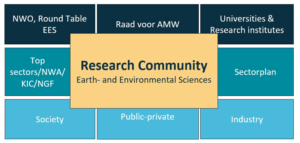
Eleven universities have jointly established the AMW Council because Earth and Environmental Sciences are crucial to the transition of our knowledge economy and a driver of innovation. And good organisation of the AMW sector in the Netherlands is essential to maintain the current high level of research and education in the AMW.
(click for larger image)
What do we want to achieve?
The AMW Council aims to strengthen the AMW sector by promoting cooperation within the sector, representing the interests of AMW in the Netherlands in the field of scientific research and academic education, and communicating the importance of fundamental and applied research in AMW to society.
What do we do?
The AMW Council:
- is the point of contact for scientific research and academic education in the AMW sector in the Netherlands;
- advises and reports to the deans of the eleven universities involved, the Minister, the sector plan committee and NWO;
- monitors national activities within the framework of the Sector Plan Science II and assists with reporting;
- promotes cooperation within the AMH sector by organising theme meetings on research topics, as specified in the Sector Plan Science II;
- encourages coordination of investment in large-scale research infrastructure;
- strives to coordinate the range of courses offered within the AMH domain;
- works together with organisations such as the Earth and Environmental Sciences Table (NWO), KNAW, NWO, TO2 and RKI institutes within the AMW domain, and the council seeks connections with professional associations, the business community, universities of applied sciences and social organisations.
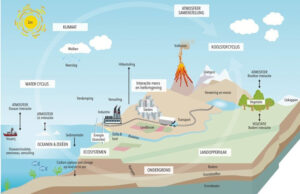
Relevant research topics (from Sector Plan Beta II):
(click for larger image)
- Carbon cycle
Human emissions and natural processes in the atmosphere, on land, in the sea and in the biosphere. - Climate change
How severe will current climate change be, what are the consequences for nature and society, and what solutions are possible? - Water cycle
Strengthening our fundamental understanding of the water cycle and the role that water plays in food production and the transport of materials, pollution and nutrients. - Sustainable energy
Innovations in the raw materials used and the development of their sustainable use, opportunities and risks of underground interventions. - Circularity and security of supply of raw materials
The effective and sustainable extraction of (critical) raw materials, including the mapping of user cycles, including recycling. - Ecosystem services
The role of ecosystem services (agriculture, fisheries, water supply, and recreation) in our safety (e.g. coastal defence through building with nature) and the creation of a healthy living environment. - Disasters and threats
Better anticipating and managing the impact of natural and man-made threats on people, the living environment, and the economy. - Food supply
Providing safe, nutritious and sufficient food for the world’s population is one of the major challenges facing the world, with sustainability and climate change expectations playing a major role. - Spatial issues
Population growth makes sustainable spatial planning increasingly important in order to enable food production and recreation, for example, even as climate change alters living conditions. - Health and environment
The health of all organisms, including humans, is highly dependent on natural and man-made changes in the environment. The relationship between human health and these changes in the Earth’s system is therefore an important research topic.

